Every services founder eventually meets the same ceiling: your revenue scales with hours, your clients' anxiety scales with silence, and your best people spend their days answering the same question. URPE Integral Services — an immigration case-preparation services firm (not a law firm; it does not provide legal advice) that works with clients entirely in Spanish — hit that ceiling with real volume behind it: more than 13,000 immigration cases of all types filed since its founding, per the firm's physical contracts and records, and a registered community of more than 35,000 people.
Its answer was to stop selling hours and start shipping product. On Aug. 19 the firm launched its client app, "URPE IS," on the App Store — the finish line of a transformation into a legaltech. Four decisions got it there, and each one translates outside immigration.
1. Sell the outcome's substance, not the paperwork
The firm's core category — the EB-2 National Interest Waiver, a self-petition green card — got dramatically harder while getting more popular: federal scrutiny of business plans and proposed endeavors tightened sharply under USCIS guidance effective January 2025. URPE's response: before any case is filed, its team builds the client's actual venture — business plan with econometrics, white papers, brand identity, a working MVP or web application, expert endorsements, certified translations — across 11 stages and 24 deliverables. The firm guarantees no outcome; no serious player can. But a client who files with an operating venture is selling reality, not promises. The lesson for any services firm: when your industry's standard of evidence rises, don't write better documents — build the thing the documents describe.
2. Give AI the availability; keep humans on judgment
URPE built a proprietary AI platform that accompanies clients 24/7 — answering questions at 2 a.m., tracking progress, keeping cases oriented — while human advisors own each phase of the work. The design principle is the part worth copying: the platform is deliberately not autonomous. Automation absorbed repetition and response time, which freed the specialists for the work that actually needs them — the economics of a venture, the strength of evidence, the coherence of a plan. More than 1,200 NIW cases are in active preparation on that hybrid today.
3. Make the process itself the product
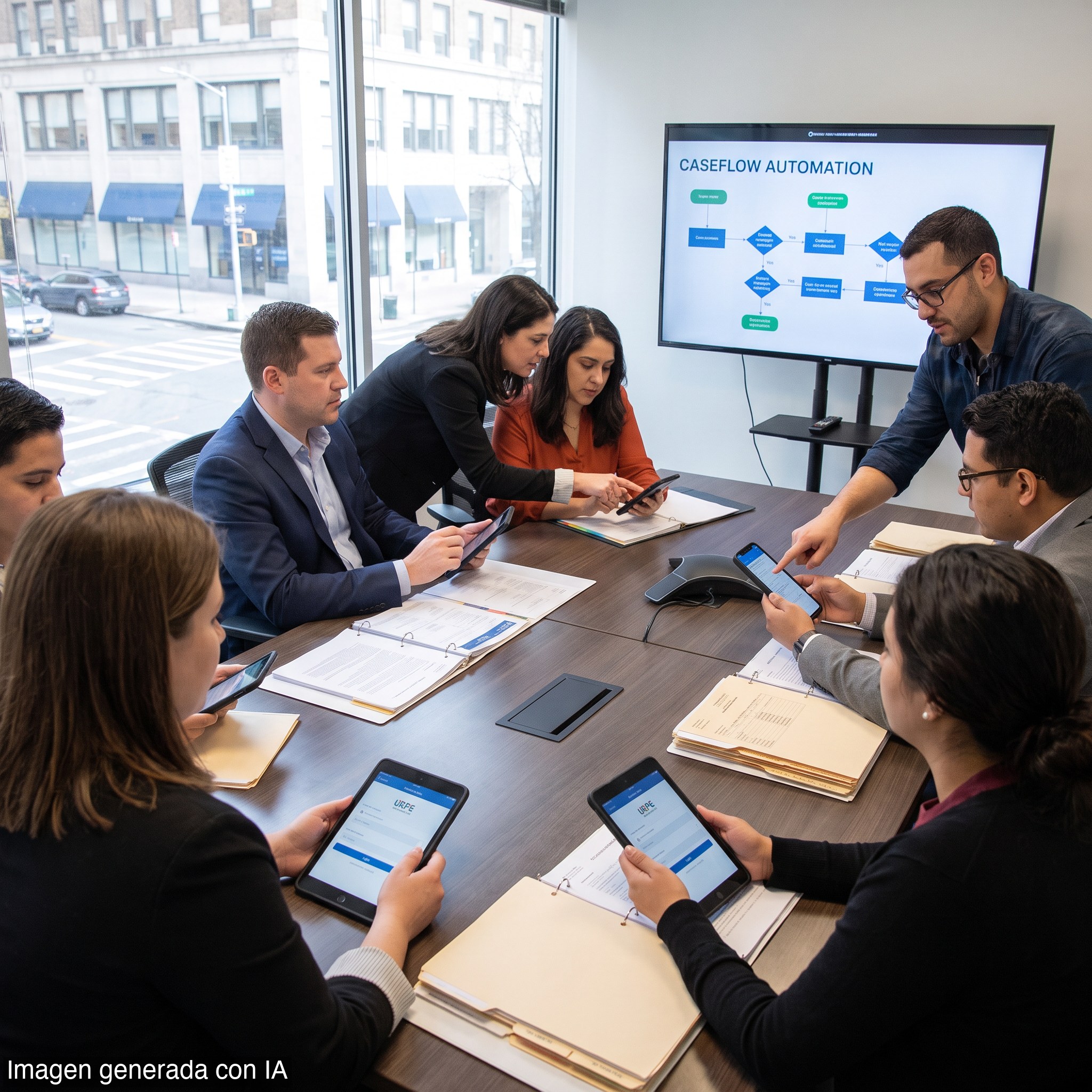
In services, the most-asked and worst-answered question is "how is it going?" With typical processing in URPE's category running around 24 months, per USCIS data analyzed by specialized publications, that question compounds for two years per client — a retention problem disguised as a communications problem. The app makes the question answer itself: real-time case stages, secure document exchange, direct messaging with the client's coordinator and advisor, stage-based payment status, and a push notification the moment a petition is filed with the government. It's free, requires an active client account, and joins the firm's web portal; an Android version is in development. Nothing in it is glamorous. That's the point — it productizes the exact anxiety clients were paying in phone calls.
4. Serve your market in its own language — as strategy, not translation
URPE operates 100% in Spanish, from first conversation to push notification. The firm cites roughly 65 million Hispanics in the U.S. as its addressable market. Most competitors treat language as a localization task; URPE made it the native experience of the entire company. If your market has a language, a culture or a channel that incumbents treat as an afterthought, that afterthought is your moat.
"Everyone says they accompany their clients. We decided to prove it in software. When your case moves, your phone knows before you would have thought to ask." — Diego Urquijo, president of URPE Integral Services
The takeaway isn't that every services firm needs an app store listing. It's that URPE stopped treating technology as a tool for the firm and started treating it as the product the client experiences. Thirteen thousand cases of every type taught it what clients fear most — the dark. The software just turned the lights on.